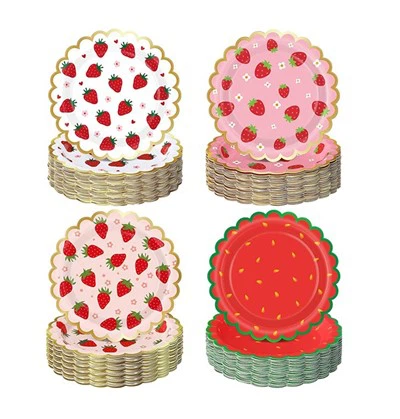
Paper plates are indispensable disposable tableware in catering, picnic, and party scenarios. They feature environmental friendliness, low cost, and convenient use. Printing is a core processing procedure for finished paper plates. It not only endows paper plates with exquisite patterns, brand logos, and decorative effects but also enhances product added value and market competitiveness.
Different from traditional paper printing, paper plate printing has stricter requirements on ink adhesion, folding resistance, food safety, and adaptability to curved surfaces because of the special thick paper material and the subsequent die - cutting, crimping, and forming processes.
This article systematically elaborates on the mainstream printing processes, standard operating procedures, key technical points, and quality control specifications of paper plate production.
1. Overview of Mainstream Paper Plate Printing Processes
At present, the paper plate printing industry mainly employs three well - established processes: flexographic printing, offset printing, and gravure printing. Each process has distinct advantages and applicable scenarios, and the selection is made based on production batch, pattern complexity, cost budget, and quality requirements.
1.1 Flexographic Printing
Flexographic printing, which belongs to relief printing, is the most widely used process in the mass production of paper plates. It utilizes flexible rubber or resin plates and water - based environmental ink that conforms to the food - grade safety standards for disposable tableware.
This process is characterized by low plate - making costs, fast production speed, strong material adaptability, and no deformation on thick paper boards. It is suitable for the mass production of conventional patterns, simple logos, and solid - color background printing. Moreover, it is compatible with subsequent high - speed die - cutting and crimping processes.
The only limitation is that it performs slightly poorly in restoring ultra - fine lines and high - gradient color layers.
1.2 Offset Printing
Offset printing is an indirect flat - printing process featuring excellent color reproduction and high pattern fineness. It can accurately reproduce complex gradients, fine text, and layered graphic designs. The printed products have flat ink layers, uniform color, and high gloss.
It is mostly used for high - end customized paper plates, holiday - themed paper plates, and brand - customized products with complex patterns. However, offset printing incurs higher plate - making costs, has slower production efficiency, and has higher requirements for paper flatness. In addition, it requires the use of food - safe offset ink to avoid potential risks of food contamination.
1.3 Gravure Printing
Gravure printing is an intaglio printing process featuring a thick ink layer, strong color saturation, and excellent three - dimensionality. The printed patterns are durable, wear - resistant, and not prone to fading. It is suitable for paper plate products with high color density requirements and large - area solid - color printing.
Nevertheless, gravure printing has high plate - making costs and a long production cycle, and it is only applicable to ultra - large - batch standardized production. At the same time, the solvent - based ink used in traditional gravure printing requires strict volatilization treatment to meet food safety standards, and now water - based gravure ink is gradually being popularized in the industry.
2. Standard Complete Printing Process Flow
The production of printed paper plates follows a standardized and streamlined process, from raw material preparation to finished product inspection. The complete process flow is as follows:
Step 1: Raw Material Inspection and Pretreatment
The base material of paper plates is mostly food - grade white cardboard, kraft cardboard, and coated cardboard. Before printing, it is necessary to inspect the paper's thickness, flatness, whiteness, and surface compactness to eliminate defective materials such as paper with burrs, concave - convex spots, and uneven thickness. Meanwhile, the paper is placed in a constant - temperature and constant - humidity workshop for balancing treatment to reduce paper shrinkage and deformation caused by environmental changes, ensuring a stable printing effect.
Step 2: Plate Making and Color Matching
According to the customer's design draft, the printing plate is made using computer plate-making technology. For flexographic printing, high-precision flexible plates are produced; for offset printing, PS plates are utilized; for gravure printing, metal intaglio rollers are engraved. Professional color-matching personnel prepare food-grade inks according to the standard color card and test the color difference to ensure that the ink color is consistent with the design standard, with uniform concentration and no precipitation.
Step 3: Formal Printing Processing
Install the debugged printing plate and qualified ink on the printing equipment, and adjust the printing pressure, printing speed, ink delivery volume, and registration accuracy. The key to this step is to control the overprint accuracy of each color to avoid color deviation, ghosting, and misalignment. During the formal printing process, conduct real - time sampling inspections to monitor ink uniformity, pattern definition, and surface cleanliness.
Step 4: Drying and Curing
After printing, the paper must pass through a constant-temperature drying channel to completely volatilize the moisture or solvent in the ink, enabling the ink layer to fully cure. Insufficient drying will lead to issues such as ink smudging, pattern peeling off, and paper adhesion in the subsequent process. The drying temperature is typically controlled at 40 - 60℃, and the drying speed is coordinated with the printing speed to ensure thorough drying without causing paper deformation and yellowing.
Step 5: Post-Printing Forming Processing
The dried printed paper will enter the die - cutting process to be cut into standard paper plate blanks. Then, edge crimping, bottom pressing, and shaping will be completed through professional paper plate forming machines. The printing process needs to reserve a reasonable crimping margin in advance to prevent the pattern from being squeezed and deformed during crimping.
Step 6: Finished Product Inspection and Packaging
After being formed, the finished paper plates are inspected comprehensively in terms of dimensions, including pattern integrity, color consistency, ink adhesion, absence of fading, absence of peculiar smell, and compliance with food safety standards. Qualified products are sorted and sealed in dust-proof and sterile packaging to complete the entire production process.
3. Key Technical Control Points in Printing
The printing quality of paper plates is affected by multiple factors, such as ink performance, equipment parameters, and the production environment. Strict control of key technical points is the core to ensure the product qualification rate.
3.1 Food Safety Control of Ink
As tableware for direct food contact, paper plates have extremely strict requirements for ink safety. All printing inks must be food-grade and environmentally friendly inks, mainly water-based inks, which are non-toxic, odorless, free of volatiles, and harmless to the human body. It is forbidden to use inks containing heavy metals, fluorescent agents, and harmful chemical components. After printing, the ink layer must be completely cured to avoid food contamination by residual solvents.
3.2 Ink Adhesion and Wear Resistance
Paper plates will be rubbed and squeezed during packaging, transportation, and use. Therefore, the ink layer must have strong adhesion. In the production process, the ink concentration and coating thickness should be reasonably adjusted, and the surface tension of the paper can be appropriately increased through corona treatment, ensuring that the ink adheres firmly to the paper surface and preventing fading, peeling, and scratching.

3.3 Overprint Accuracy and Color Difference Control
For multi - color printed paper plates, overprint accuracy directly determines the fineness of patterns. The equipment should be regularly debugged to ensure that the color registration error is controlled within ±0.1mm. Meanwhile, unified color - matching standards and regular color sampling comparisons are adopted to eliminate batch color differences and ensure consistent color of the finished products in the same batch.
3.4 Anti-Deformation Control
Thick paper is prone to shrinkage, warping, and deformation due to the influence of ink moisture and temperature during printing. It is necessary to maintain a constant temperature (22 - 25°C) and constant humidity (50% - 60%) in the workshop environment, control the ink water content and drying temperature, and prevent paper deformation from affecting subsequent forming and appearance quality.
4. Common Quality Problems and Optimization Solutions
In the actual production of paper plate printing, there are some common quality defects. Targeted optimization can effectively improve product quality and yield.
4.1 Ink Smudging and Blurring
Causes: insufficient drying temperature, excessive ink delivery volume, overly fast printing speed, and high humidity in the workshop. Optimization measures: appropriately increase the drying temperature and extend the drying time, adjust the ink delivery system to reduce the single - ink output, moderately reduce the printing speed, and dehumidify the workshop to keep the environment dry.
4.2 Pattern Fading and Peeling
Causes: unqualified ink quality,Insufficient ink curing and low paper surface tension. Optimization measures: Replace qualified food - grade ink, strengthen the drying and curing treatment, and conduct corona pretreatment on the paper before printing to improve ink adhesion.
4.3 Overprint Misalignment and Color Ghosting
Causes: equipment operation error, loose printing plate, paper feeding deviation. Optimization measures: regularly maintain and debug printing equipment, fasten the printing plate, calibrate the paper Feeding system, and check the overprint accuracy in real time during production.
4.4 Batch Color Difference
Causes: unstable ink ratio, inconsistent equipment parameters, environmental temperature and humidity fluctuation. Optimization measures: unified ink proportioning standard, fixed equipment operation parameters, production in a constant - temperature and constant - humidity workshop, and regular color comparison and sampling inspection.

5. Industry Development Trend
With the continuous improvement of global environmental protection requirements and consumer quality demands, paper plate printing technology is developing towards green environmental protection, high definition, personalized customization, and intelligent production. On the one hand, water - basedFlexographic printing will further replace traditional solvent-based printing processes, and all food-grade green printing materials will become the industry standard.
On the other hand, digital printing technology is gradually being applied to small-batch and personalized customized paper plate production, enabling the flexible production of variable patterns and quick order response.
In addition, intelligent printing equipment with automatic detection and error correction functions will effectively reduce manual errors, improve production efficiency and product stability, and promote the standardized and high-quality development of the paper plate printing industry.
Conclusion
Paper plate printing is a comprehensive process integrating material selection, plate making, printing, drying and post-processing. Its core production logic is to balance food safety, appearance quality and production efficiency. Enterprises need to select appropriate printing processes according to product positioning, strictly control every technical link in production, continuously optimize quality problems in the production process, and keep up with the trend of green and intelligent industry development, so as to produce high-quality, safe and beautiful printed paper plate products and meet the diversified market demands.