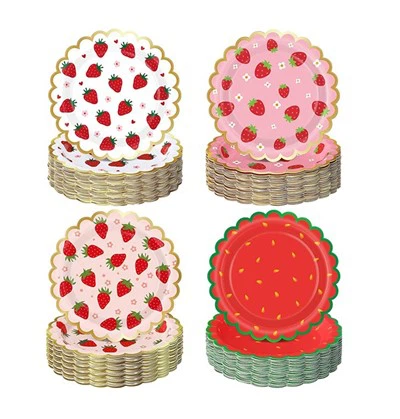
In the fast-paced modern life, disposable paper plates, with their convenience, are widely used in various scenarios such as family dinners, outdoor picnics, party celebrations, and canteen meals. They have become a common item for people to simplify their lives and reduce housework burdens. Made mainly of paper through processing and molding, they have both practicality and certain environmental attributes, but at the same time, they also have many limitations. This article will comprehensively analyze the advantages and disadvantages of disposable paper plates to help everyone rationally view their use value and potential impacts.
I. Advantages of Disposable Paper Plates
(1) Convenient to Use and Time-Saving
This is the most prominent advantage of disposable paper plates. After use, they do not need to be cleaned and can be discarded directly, completely eliminating the cumbersome process of washing, drying, and storing dishes. They are especially suitable for occasions with a large number of people, such as family gatherings, company team building, and outdoor camping. For busy office workers and outdoor enthusiasts, disposable paper plates can greatly simplify the cleaning work after meals, allowing people to devote more time to the activity itself and improve the experience. In addition, most disposable paper plates are pre-formed, which can be used directly after opening the package without additional tableware preparation, and they are also very light and easy to carry for outdoor use.
(2) Low Cost and High Cost-Effectiveness
The main raw materials for disposable paper plates are waste pulp and wood pulp, which are easy to obtain and low in cost. In addition, the production process is mature and the mass production scale is large, so their prices are generally affordable. Whether for daily household use or bulk purchase by businesses and institutions, it will not cause excessive economic burden. Compared with durable tableware such as ceramic plates and glass plates, disposable paper plates do not need to worry about breakage and loss, nor do they need to invest in maintenance costs. For short-term use and temporary needs, their cost-effectiveness is far higher than that of durable tableware.
(3) Environmentally Friendly Material, Better Degradability Than Plastic
Compared with disposable plastic plates, disposable paper plates have obvious environmental advantages. High-quality disposable paper plates are made of natural plant fibers, which can be gradually degraded in the natural environment. After decomposition, they will not produce non-degradable white garbage like plastic, nor will they cause long-term pollution to soil and water sources. In addition, many disposable paper plates are made of recyclable waste paper, realizing the recycling of resources, reducing wood consumption, and conforming to the concept of green and environmental protection, which is suitable for consumers who pay attention to environmental protection.
(4) Safe and Non-Toxic, More Assuring to Use
Disposable paper plates produced by regular manufacturers adopt food-grade raw materials and environmentally friendly ink, and have passed strict quality inspections. They do not contain harmful substances, will not chemically react with food during use, and will not cause harm to human health. Compared with the toxic substances that may be released by some inferior plastic plates, disposable paper plates are more secure in safety, especially suitable for sensitive groups such as children and the elderly, and can also be used to directly hold cooked food, fruits and other foods.
(5) Diverse Styles, Suitable for Different Scenarios
To meet the needs of different scenarios, disposable paper plates have a variety of styles and specifications. There are not only simple solid-color paper plates, but also decorative paper plates printed with exquisite patterns and designs, which can be flexibly selected according to the party theme and dining scene to enhance the sense of ritual of dining. In terms of specifications, there are all sizes from small paper plates suitable for holding snacks and fruits to large paper plates suitable for holding staple foods and dishes, which are suitable for various use scenarios such as families, businesses and outdoors.
II. Disadvantages of Disposable Paper Plates
(1) Poor Load-Bearing Capacity, Prone to Breakage and Leakage
The inherent characteristics of paper determine that disposable paper plates have limited load-bearing capacity, especially when they encounter water and oil, they are easy to soften and break. If holding food with more soup and high oil content, the paper plate is likely to leak, which will not only dirty the tabletop and clothes, but also affect the dining experience. In addition, the hardness of the paper plate is insufficient, and when holding heavy food, it is prone to deformation and collapse, which limits its use range and cannot be used to hold heavy objects or food with high temperature, high oil and high soup.
(2) Poor Durability, Cannot Be Reused
The original design intention of disposable paper plates is "one-time use". Their structure is simple and the material is thin. After one use, they will soften and break, and cannot be reused. This means that they need to be discarded after each use. Long-term and large-scale use will produce a lot of garbage. Although they are degradable, they will still increase the environmental treatment pressure and cause a certain waste of resources. Compared with reusable tableware such as ceramics and glass, disposable paper plates have obvious gaps in durability, and the comprehensive cost of long-term use may be higher.
(3) Environmental Hidden Dangers in Some Products
Although high-quality disposable paper plates have the advantage of degradability, some inferior paper plates on the market will be coated with a layer of inferior plastic coating or chemical waterproof agent on the surface to improve water and oil resistance. Such paper plates cannot be naturally degraded, and may release harmful chemical substances during use, polluting food and endangering human health. In addition, some manufacturers use inferior waste paper to process paper plates to reduce costs, which may contain impurities and bacteria, posing hygiene hazards and affecting use safety.
(4) Limited Applicable Scenarios, Greatly Affected by the Environment
The use of disposable paper plates is greatly affected by the environment. In humid and high-temperature environments, paper plates are prone to softening and breaking in advance and cannot be used normally. For example, when used outdoors on rainy days, the paper plate will break quickly when exposed to water; when holding high-temperature food, the paper plate may soften due to heat, resulting in deformation and leakage. Therefore, it is more suitable for use in dry and normal temperature environments, and cannot be adapted to all dining scenarios, especially occasions with high requirements for tableware stability.
(5) Resource Consumption Still Exists
Although disposable paper plates are degradable and recyclable, their production still requires a lot of wood, water resources and energy. Long-term and large-scale production and use of disposable paper plates will indirectly increase the amount of deforestation, consume limited natural resources, and do not conform to the concept of "low-carbon life". In addition, the production, transportation and recycling processes of paper plates will also produce a certain amount of energy consumption and environmental pollution, and their environmental protection is relative rather than absolute.
III. Conclusion
As a convenient and economical tableware, disposable paper plates can bring great convenience to people's lives in specific scenarios. Their environmental protection and safety advantages also make them a high-quality choice to replace plastic tableware. However, they also have disadvantages such as poor load-bearing capacity, poor durability and limited applicable scenarios, and some inferior products also have safety and environmental hazards.
Therefore, when using disposable paper plates, we should choose rationally: give priority to high-quality products produced by regular manufacturers, without plastic coating and degradable; choose reasonably according to the use scenario, and avoid using them in scenarios with high temperature, high oil and high soup; reduce unnecessary use, try to use reusable tableware for daily family meals, and use an appropriate amount in temporary scenarios such as outdoors and parties. After use, do a good job in classification and recycling to minimize their impact on the environment. Only by using them reasonably and choosing them scientifically can disposable paper plates truly serve life, while taking into account environmental protection and safety.